Active restaurant conversations are frequently hard to decipher when surrounding background noise clashes with your hearing. Our specialists can evaluate hearing under both calm and noisy listening conditions to establish why noisy rooms present such difficulty. After uncovering the precise factors driving your difficult hearing, our team helps you select individualized auditory solutions.
How Can Hearing Seem Normal at Home but Fail in a Restaurant?
Low-noise environments yield an advantageous signal-to-noise ratio where primary speech remains significantly louder than background sound. Busy dining establishments generate the exact reverse scenario. Overlapping chatter, piped music, kitchen clatter, and hard-surface reverberation mask speech, forcing the brain to expend immense cognitive effort to track conversation.
These communication barriers frequently indicate high-frequency hearing loss, central auditory-processing disorders, or age-related sensorineural changes. Attention, fatigue, dim lighting, and distance from the speaker may make it worse. Many individuals register normal audiometric thresholds on standard pure-tone screenings yet show profound deficits during speech-in-noise testing. Communication breakdowns in loud restaurants should be professionally assessed even if one-on-one listening feels uncompromised.
Diagnostic Protocols for High-Frequency Hearing Loss
Diagnostic assessment begins by documenting specific listening breakdowns, recreational noise exposure, tinnitus symptoms, medications, and hereditary auditory patterns.
Through pure-tone audiometry, we determine your faintest auditory perception across low to high pitches utilizing both air and bone conduction testing. Sensorineural high-frequency hearing loss demonstrates an audiometric slope reflecting diminished hearing thresholds as sound frequencies climb. Additional testing may include tympanometry to assess middle-ear function and word-recognition testing to measure speech understanding.
Because testing in a silent booth does not mirror real-life restaurant environments, speech-in-noise testing supplies vital diagnostic clarity. It evaluates sentence-level speech comprehension as competing background babble increases in volume. Together, these results show whether the problem involves audibility, speech clarity, background-noise processing, or a combination of factors.
Adult Auditory Processing Disorders and Speech Perception
A diagnosed auditory processing disorder affects how the brain’s auditory cortex analyzes, organizes, and interprets sound. While peripheral ears may register soft tones normally, the auditory cortex struggles to filter competing noise, resolve phonetic contrasts, or keep pace with rapid conversation. We first evaluate peripheral hearing and then determine whether an individualized auditory-processing test battery or referrals to other professionals are appropriate.
How to Improve Speech Clarity in Challenging Acoustic Environments
Minor environmental adjustments can boost speech acoustic signals and supply critical visual lip-reading cues. When planning to dine out, select restaurants with calmer atmospheres or arrange reservations during off-peak hours. Dining locations utilizing sound-absorbing elements like booths, felt panels, window curtains, and carpet offer better acoustics than high-ceilinged rooms with hard surfaces.
Practical seating strategies in the dining room:
- Select a secluded table situated away from prep kitchens, crowded bar stations, loudspeaker zones, and large parties.
- Choose a seat with your back against a solid wall to block acoustic clutter originating from behind.
- Position yourself directly opposite your companions where direct lighting highlights their facial expressions.
- Sit as close to the speaker as comfort permits to preserve speech volume and clarity.
- Turn your better-hearing ear toward the specific speaker you want to hear most clearly.
- Prompt companions to rephrase unclear sentences with alternate terminology instead of repeating identical words.
- Actively confirm key information rather than smiling and guessing at ambiguous dialogue.
- Take a brief listening break when fatigue begins to build.
- Encourage friends to enunciate clearly while maintaining an even, normal conversational tempo.
- Speaking with excessive volume creates acoustic distortion that fails to make words clearer.
Advanced Technology for Hearing in Background Noise
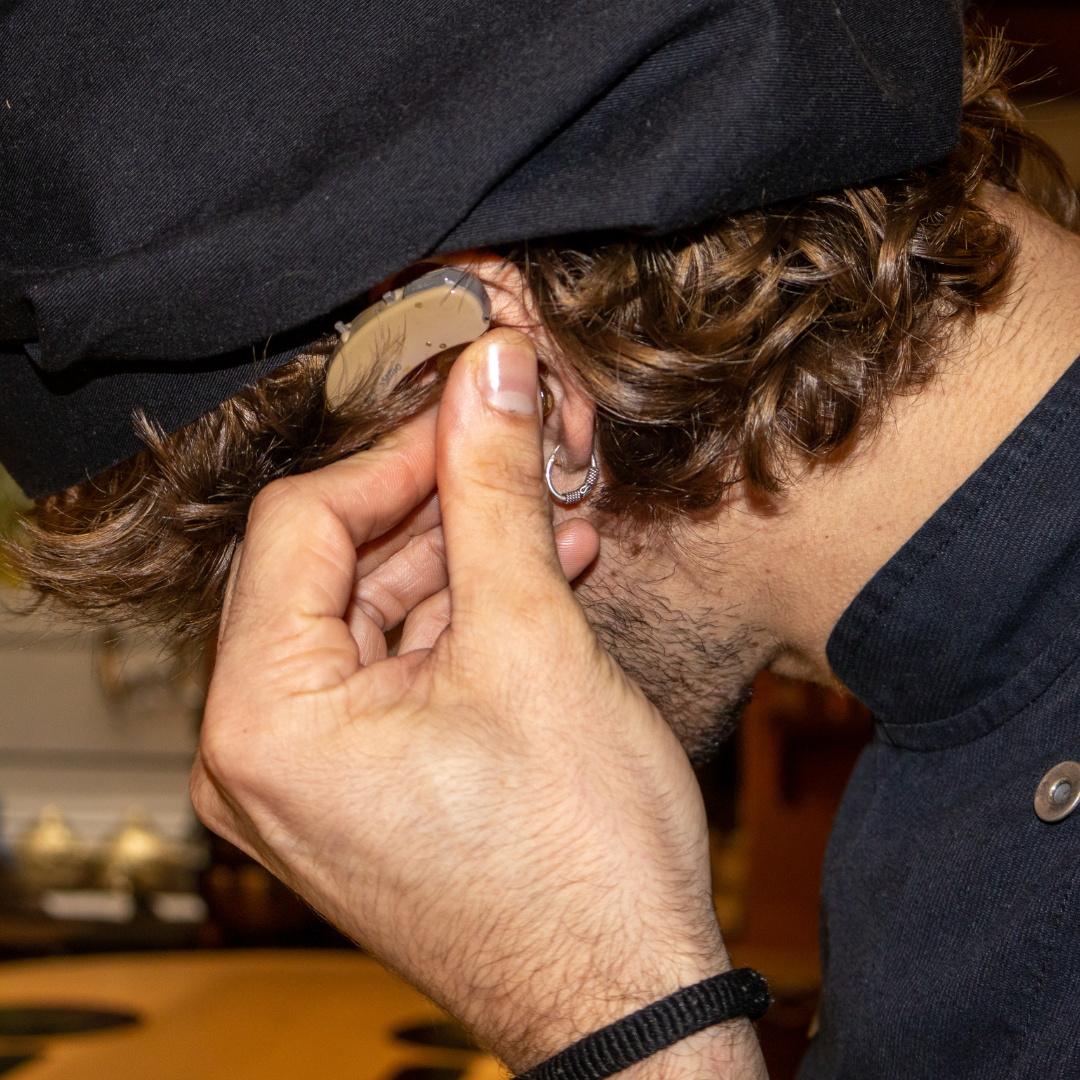
Appropriate hearing technology is dictated by the precise diagnosis, primary listening environments, and the degree of diagnosed hearing loss. Customized hearing aids employ directional microphone beamforming, noise cancellation algorithms, and targeted dining programs to prioritize speakers in front while lowering ambient noise. However, users must maintain realistic expectations, as no clinical technology can eliminate every competing background speaker entirely.
Incorporating a dedicated remote microphone provides an even more pronounced improvement in signal-to-noise ratio. The microphone is placed near or worn by the speaker and sends that voice directly to compatible hearing aids or another receiver. This wireless transmission substantially diminishes the acoustic degradation caused by physical distance and ambient room noise.
Other useful options include:
- Dedicated table microphones engineered to capture small-group dialogue
- Integrated telecoil programs for tapping into venue-wide induction loop systems
- Mobile device live-captioning programs and speech-to-text transcription software
- Modern wireless hearables delivering directional beamforming and sound enhancement
- Decibel-level applications and restaurant rating guides for finding quiet tables
We evaluate these technological options, ensure full hardware compatibility, and instruct you on maximizing your selected system.
Professional Audiological Solutions for Loud Listening Environments
A thorough audiological evaluation expands the diagnostic scope well past simple quiet listening performance. We can review the places, speakers, and noise levels that cause problems and select tests that reflect those concerns. Testing routinely combines pure-tone audiometry, middle-ear impedance tests, speech discrimination, and speech-in-noise measures. Advanced auditory-processing testing can be introduced whenever medical history and baseline assessments justify specialized evaluation.
Abrupt auditory reductions, unilateral hearing shifts, or rapid functional deterioration require prompt assessment by an ear, nose, and throat physician. Tailored audiological treatment identifies the exact origin of listening breakdown rather than assuming environmental dining noise is the sole culprit.
Request an Audiology and Hearing Evaluation Today
When dining out causes you to guess at words, detach from family, or experience severe listening exhaustion, book a comprehensive hearing evaluation with us. We can evaluate targeted solutions to optimize your hearing in noisy environments using prescription hearing aids, assistive listening technology, or communication strategies tailored to you.
Get in touch with our team to request an appointment and rediscover confident, stress-free restaurant conversations.