
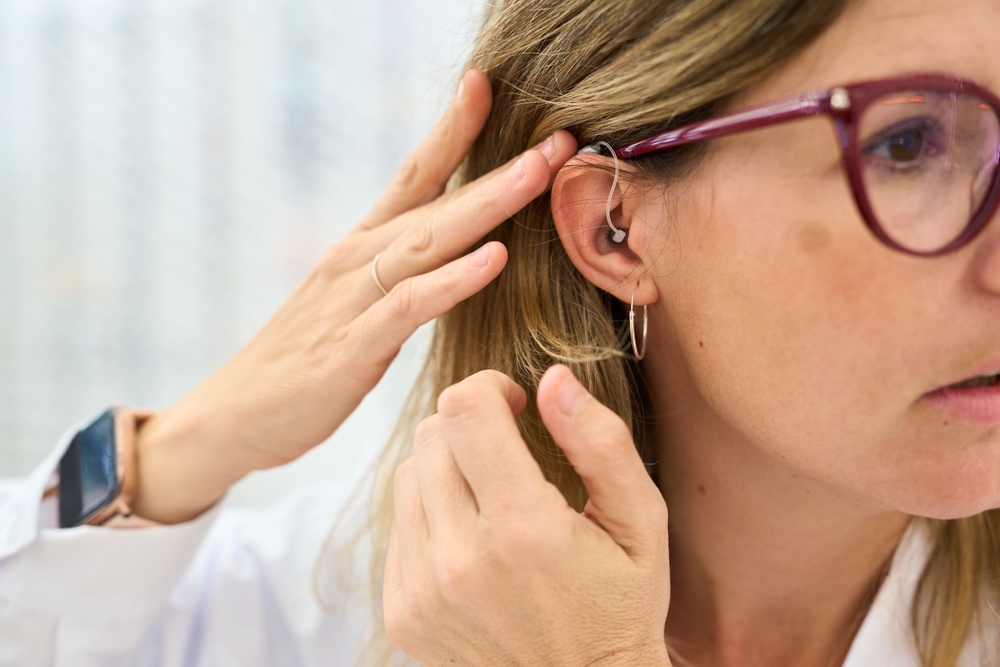
Many people delay getting hearing aids because they don’t think they’ll like how they look or feel. For decades, legacy acoustic amplifiers were cumbersomely large, highly conspicuous, and culturally tethered to physical senescence. Regrettably, some people even experienced social alienation because acquaintances falsely assumed that wearing a visible aid signaled a complete inability to comprehend spoken dialogue.
For many people, this image has stuck, making them hesitant to take the next step. The liberating truth is that twenty-first-century auditory tech offers a level of cosmetic elegance and physical comfort that surprises most patients. Ongoing innovations in cosmetic engineering mean today’s options are ultra-small, seamlessly comfortable, and beautifully hidden from public view.
If you’ve been putting off treatment because of how hearing aids used to look, it might be time to take a fresh look at what’s available today!
Why the Bulky, Obvious Hearing Aid Is a Thing of the Past
If you close your eyes and picture a hearing aid, you might imagine something large, hooked over the ear, and visible from across the room. If that is the visual you hold, you are fundamentally remembering outdated medical equipment from decades past.
Since that era, the manufacturing landscape for hearing solutions has completely transformed. Unprecedented breakthroughs in microchip architecture, material sciences, and digital signal processing have utterly revolutionized modern aesthetics. Today’s instruments are profoundly smaller, remarkably streamlined, and strategically engineered to blend flawlessly into your natural anatomy or vanish altogether.
A substantial percentage of contemporary options reside deep within the auditory canal, ensuring absolute invisibility during routine face-to-face interactions. Different configurations sit comfortably behind the ear but feature such a low profile and featherweight build that observers naturally miss them.
Understanding Your Options: A Guide to Contemporary Device Form Factors
For those investigating what these advanced acoustic tools look like in real life, consider this straightforward guide:
The Invisible-in-Canal (IIC) Form Factor
This tier represents the absolute pinnacle of cosmetic concealment. IIC devices sit completely inside the ear canal and are custom-made to fit your ear. When engaging with others at standard social distances, these units are utterly unnoticeable to the naked eye. This configuration is highly favored by individuals managing mild-to-moderate auditory drops who demand total aesthetic secrecy.
Modern Standards: Receiver-in-Canal (RIC) / Receiver-in-the-Ear (RITE)
Statistically, this open-fit design represents the dominant choice among current consumers. A micro-housing rests behind the upper pinna, transferring processed sound via an ultra-fine, translucent micro-wire to an acoustic driver nestled inside the canal. To a casual observer, their clean lines often mimic high-end commercial wireless earbuds. Most people won’t notice them unless they’re looking.
Traditional Behind-the-Ear (BTE) Reimagined
This style positions the main component body post-auricularly, offering a slightly larger footprint that remains beautifully sculpted and sleek. They are typically prescribed to resolve advanced levels of hearing impairment, generating exceptional sound amplification without the cumbersome weight users traditionally dread.
The fundamental lesson is clear: current acoustic technology is engineered to integrate seamlessly into your personal lifestyle, never to advertise an impairment.
Modern Hearing Aids: Looking Better and Doing a Lot More
The changes in modern hearing aids aren’t just cosmetic. Present-day models perform like advanced personal audio computers instead of basic medical listening aids. Most current systems boast universal wireless syncing, channeling smartphone calls, high-definition music, and television broadcasts directly to your internal receivers.
Most come with smartphone apps, so you can adjust volume or switch settings without ever touching the device. If you enter a chaotic, crowded room, you can optimize your digital noise reduction settings to isolate speech within seconds. Advanced rechargeable battery banks have effectively replaced the small, fragile power cells that used to cause immense frustration. Just place them on a charger overnight, like your phone.
Getting Over the Fear and Stigma of Hearing Devices
Even with this encouraging information, taking the initial step toward treatment can induce anxiety. Exploring hearing aid options can be challenging on a mental and emotional level because it’s an admission that our hearing isn’t what it used to be. Such moments frequently spark an uncomfortable sense of vulnerability, as though we are losing command over our physical frames.
But here’s a different way to look at it: Hearing aids aren’t a sign that something has gone wrong. They are merely an intelligent adaptation to a universal milestone of aging that impacts us all eventually. Choosing to hear better is absolute evidence that you are choosing to optimize your body and enhance your overall quality of life.
Visualize the freedom of utilizing a completely covert acoustic system that restores your ability to track jokes, engage in crowded restaurants, and capture every nuance of the activities you love. That level of sensory restoration is incredibly liberating!
Discover the Reality of Modern Otolaryngological Solutions
The quickest way to erase your grandfather’s mental model is to physically interact with twenty-first-century hearing tech. We invite you to come in, ask questions, and explore your options with no pressure and no commitment necessary. Treat this as a risk-free exploratory step to comprehend the incredible aesthetic shift that has occurred in our field.
The overwhelming majority of our patients leave their consultation thoroughly amazed by the compact scale, luxurious comfort, and acoustic clarity of current technology! Call our office to schedule your visit online today.